Why Architects and Designers Prefer Working with a 3D Modelmaker Today
In today’s competitive world of architecture and design, the ability to communicate ideas visually has become more important than ever. Clients, investors, and stakeholders want to see realistic representations of projects before they are built. While sketches, blueprints, and 2D renders have their place, nothing compares to the impact of a 3D architectural model created by a skilled 3D modelmaker.
Whether for architectural presentations, product prototypes, or urban planning models, professional modelmakers are redefining how architects and designers showcase their creativity. Let’s explore why the demand for 3D modelmakers is growing rapidly, and why design professionals prefer working with them today.

The Role of a 3D Modelmaker
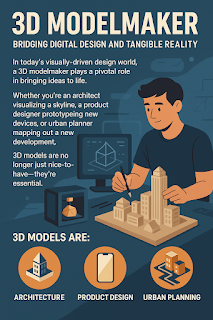
A 3D modelmaker specializes in transforming digital concepts into tangible, physical models. Using advanced 3D printing, CAD software, and model-making techniques, they bridge the gap between imagination and reality.
Instead of simply presenting a flat drawing or computer render, architects and designers can work with modelmakers to produce detailed scale models that highlight every aspect of their design—from structural layouts to aesthetic finishes. This not only makes projects more impressive but also helps clients visualize outcomes with absolute clarity.
Why Architects Prefer 3D Modelmakers
1. Enhanced Visualization for Clients
Architectural projects are complex, and many clients struggle to interpret 2D plans. A 3D model architecture makes it easy to understand proportions, textures, and spatial relationships.
When architects present physical models crafted by a 3D modelmaker, they create emotional engagement and a deeper sense of trust. Clients can see the project from every angle, leading to quicker decision-making and fewer misunderstandings.
2. Accuracy and Precision
Modern 3D modelmakers use advanced 3D printing technologies such as SLA (stereolithography) to achieve high-resolution details. This precision is invaluable when architects want to demonstrate:
Intricate façade designs
Window placements
Complex roof structures
Interior layouts
This accuracy ensures that stakeholders get a realistic and true-to-scale representation of the proposed design, minimizing the risk of costly revisions later.
3. Time-Saving for Design Iterations
Architects often face multiple revisions before final approval. Redrawing and rendering can be time-consuming, but a 3D modelmaker can produce quick variations and updated models efficiently.
Instead of relying solely on computer screens, design teams can compare physical prototypes side by side, making it easier to refine concepts, resolve issues, and achieve faster project approvals.
4. Professional Presentation in Competitions & Bids
In architectural competitions, first impressions matter. A well-crafted model by a 3D modelmaker instantly elevates a presentation, making it stand out among dozens of entries.
Judges and clients are more likely to remember and connect with a design that is visually impactful and physically engaging, rather than a simple digital render.
5. Stronger Collaboration Between Teams
A physical 3D architectural model is not only for clients—it also improves collaboration between architects, designers, engineers, and construction teams.
When all stakeholders can physically examine a model, it becomes easier to:
Identify potential design flaws
Adjust structural elements
Plan construction phases
This collaborative approach reduces errors and improves efficiency throughout the project lifecycle.
Why Designers Rely on 3D Modelmakers
1. Turning Creative Ideas into Reality
For product designers, furniture makers, and industrial innovators, a 3D modelmaker turns abstract ideas into functional prototypes. This allows them to test shapes, ergonomics, and usability before full-scale production.
2. Cost-Effective Prototyping
Instead of investing heavily in manufacturing a first sample, designers can partner with a 3D printing bureau or modelmaker to produce prototypes at a fraction of the cost. This helps businesses validate ideas before committing to mass production.
3. Flexibility Across Industries
A skilled 3D modelmaker is not limited to one industry. They serve:
Architecture – Scale models for planning & presentations
Interior Design – Furniture and décor prototypes
Engineering – Machine components and product parts
Medical – Anatomical models for training & research
Film & Entertainment – Props, miniatures, and set models
This versatility makes them indispensable in creative industries.
3D Modelmaker vs Traditional Model Maker
Traditional hand-crafted models have artistic value, but they can be time-consuming, costly, and less precise compared to modern 3D printed architectural models.
A 3D modelmaker combines craftsmanship with digital tools, offering the best of both worlds—hand finishing for realism and 3D printing for speed and accuracy. This blend of old and new techniques is why architects and designers prefer them over purely traditional methods.
The Future of 3D Modelmaking in Architecture & Design
With the rise of smart cities, sustainable buildings, and rapid prototyping, the demand for 3D modelmakers in London and globally will only increase. As projects grow in complexity, the need for visual storytelling, client engagement, and precision modeling will remain at the heart of design.
Architects and designers who embrace collaboration with professional 3D modelmakers will continue to gain a competitive advantage, ensuring their ideas are not only seen but truly experienced.
Conclusion
In a world where visuals drive decision-making, working with a 3D modelmaker is no longer an option—it’s a necessity. From architectural firms to product design studios, professionals are turning to these experts for accuracy, efficiency, and client engagement.
By bridging the gap between digital concepts and physical reality, 3D modelmakers empower architects and designers to communicate ideas effectively, win more projects, and create timeless designs.
👉 If you are an architect or designer looking to bring your ideas to life, collaborating with a professional 3D modelmaker is the smartest choice you can make today.


Comments
Post a Comment