From Digital Files to Physical Models: UK 3D Printing for Modern Designers
In today’s design landscape, turning conceptual ideas into tangible, functional, and visually appealing models is more important than ever. While digital software and CAD models enable designers to visualize projects in three dimensions, physical models continue to play a critical role in communication, decision-making, and presentation.
UK 3D printing services have revolutionized how designers, architects, and product developers approach modelmaking. By providing high-precision, efficient, and professional additive manufacturing solutions, these services bridge the gap between digital design and physical reality. This article explores how UK 3D printing enables modern designers to streamline workflows, enhance creativity, and bring concepts to life faster and more reliably than ever before.

1. The Role of 3D Printing in Modern Design
For designers, the ability to iterate quickly and accurately is essential. Traditional modelmaking, while artistic, is often time-consuming, labor-intensive, and limited in precision. UK 3D printing services offer solutions to overcome these challenges:
High Accuracy: Advanced printing technologies produce models that match CAD files to exact specifications.
Rapid Prototyping: Digital models can be converted to physical prototypes within hours or days, enabling faster iteration.
Presentation-Ready Models: With professional finishing, models become polished, realistic, and visually engaging.
Material Flexibility: Multiple materials allow designers to experiment with textures, strength, transparency, and colors.
By leveraging these capabilities, designers can enhance communication with clients, stakeholders, and collaborators while reducing errors and material waste.
2. The Workflow: From Digital Files to Physical Models
Step 1: CAD Design and File Preparation
Everything begins with a digital 3D model. Designers use software such as AutoCAD, Rhino, SolidWorks, or Revit to create highly detailed designs. Professional 3D printing bureaus assist in:
Optimizing files for printing accuracy
Checking for geometry errors or unsupported features
Scaling models for the intended physical output
Suggesting suitable materials and printing techniques
A well-prepared CAD file ensures a smooth printing process and reduces the risk of errors or delays.
Step 2: Choosing the Right 3D Printing Technology
UK 3D printing services provide a variety of technologies tailored to project requirements:
FDM (Fused Deposition Modeling): Cost-effective and ideal for rapid prototyping
SLA (Stereolithography): Produces high-detail, smooth-surface models for client presentations
SLS (Selective Laser Sintering): Strong and functional parts for engineering or product testing
Hybrid Approaches: Combining multiple methods to achieve complex geometries or multi-material models
Selecting the right technology ensures accuracy, speed, and visual fidelity for the final model.
Step 3: Printing and Post-Processing
Once printing is complete, models undergo professional post-processing to ensure they are ready for presentation or functional use:
Assembly of multiple printed parts
Sanding, polishing, and painting for a refined finish
Mounting on bases or enclosures for exhibitions, pitches, or client presentations
This combination of digital precision and expert finishing ensures that each model meets high-quality standards.
3. Applications Across Industries
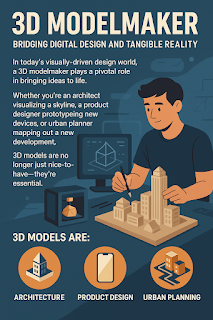
a) Architecture and Urban Planning
Scale models for buildings, interiors, and cityscapes
Visualization of spatial relationships, circulation, and landscaping
Effective presentation tools for clients, planning authorities, and competitions
b) Product Design and Engineering
Prototypes to test form, function, and ergonomics
Iterative cycles for faster refinement
Cost-effective evaluation before mass production
c) Creative Arts, Exhibitions, and Education
Exhibition-ready sculptures or installation models
Teaching aids and research prototypes
Miniature storytelling through high-detail, accurate models
4. Benefits of Partnering with a UK 3D Printing Service
Faster Iteration: Turn designs into physical models quickly, enabling rapid feedback and adjustments
Precision and Detail: High-resolution printing ensures models match CAD designs closely
Cost-Efficiency: Reduces material waste and the need for expensive in-house equipment
Access to Expertise: Professional bureaus provide advice on materials, finishes, and optimal workflows
Enhanced Presentations: Finished models are visually compelling and client-ready
Focus on Creativity: Designers can concentrate on innovation rather than technical fabrication
By outsourcing fabrication to professional bureaus, designers can accelerate innovation, save time, and elevate project quality.
5. Case Studies: Real-World Impact in the UK
Architectural Firm: Created a 1:150 scale urban development model using SLA 3D printing, enabling faster stakeholder approvals and early identification of design challenges.
Product Design Studio: Produced multiple functional prototypes of a consumer device, reducing the development cycle by 35% and improving design quality.
Art Exhibition: Combined 3D printed components with hand-painted details to produce high-impact miniature models for gallery displays, enhancing portfolio visibility and engagement.
These examples demonstrate how UK 3D printing services help designers iterate faster, communicate better, and produce high-quality results.
6. Choosing the Right 3D Printing Partner in the UK
When selecting a service, consider:
Range of printing technologies (SLA, SLS, FDM, hybrid)
Variety of materials and finishes
Expertise in file preparation and post-processing
Reliability and turnaround times
Portfolio of previous architectural, product, or creative projects
A trusted UK bureau like Fixie3D combines technology, craftsmanship, and efficiency, providing end-to-end solutions for modern designers.
7. The Future of 3D Printing in the UK
The future of 3D printing is bright, with innovations such as:
Sustainable materials for environmentally friendly models
AR/VR integration for immersive presentations
AI-assisted design optimization for faster, smarter printing
Large-scale additive manufacturing for architecture and industry
These developments will allow UK designers to iterate faster, innovate freely, and produce physical models with greater accuracy and efficiency.
Conclusion
3D printing in the UK has become an essential tool for modern designers, architects, and creative professionals. By bridging the gap between digital files and physical models, professional services enable:
Faster iteration and innovation
Accurate, high-quality model production
Cost savings and reduced material waste
Enhanced client presentations and stakeholder communication
Partnering with a reliable UK 3D printing service like Fixie3D ensures that your ideas are realized quickly, efficiently, and with professional polish, making it an indispensable part of today’s design workflow.


Comments
Post a Comment