What Are 3D Architectural Models and Why Do Architects Still Use Them in a Digital Age?
In an era of photorealistic renders, immersive VR walkthroughs, and AI-generated visualisations, it might seem like the physical architectural model has had its day. Yet walk into any leading architecture practice, planning office, or competition jury room, and you'll likely still find one sitting proudly on the table. Far from being a relic of the past, 3D architectural models remain one of the most powerful tools architects have for communicating design intent. Here's why.
What Is a 3D Architectural Model?
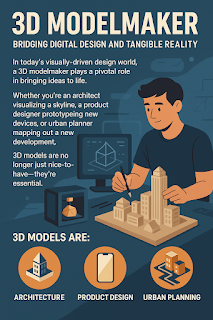
A 3D architectural model is a physical, three-dimensional representation of a building, structure, or masterplan, built to a specific scale. Traditionally, these models were constructed by hand using materials like card, foam board, timber, and plaster. Today, many are produced using 3D printing technology, which translates a digital CAD or BIM file directly into a precise physical object.
At Fixie 3D, for example, models are created using laser-based stereolithography (SLA) 3D printing, a process that uses a laser to cure liquid resin layer by layer, producing highly detailed, smooth-finished models. Once printed, models can be further refined by hand through spray painting, assembly, and mounting to create a polished, presentation-ready piece.
These models can range from small-scale concept massing studies to large, multi-piece city or site models, depending on the project's needs.

Why 3D Architectural Models Still Matter Alongside Digital Tools
1. They offer a Tangible, Spatial Understanding.Digital renders and walkthroughs are excellent at showing how a space looks, but 3D architectural models let clients, planners, and stakeholders hold a design in their hands and view it from any angle simultaneously. There's a reason the human brain often grasps scale, proportion, and massing more intuitively from a physical object than from a screen. A model invites people to walk around it, lean over it, and look at it from above, in a way that no monitor can replicate.
2. They Build Trust and Credibility in Client Presentations
For architects, client presentations are high-stakes moments. A well-made 3D architectural model signals professionalism, attention to detail, and confidence in the design. It gives clients something memorable to engage with during a meeting, and often becomes a centrepiece that anchors the conversation, rather than a slide that flashes past on a screen.
3. They're Essential for Competitions
In architectural competitions, where dozens of practices may be vying for the same project, a striking physical model can be the difference between a design that's remembered and one that blends into the background. Competition models are typically built to a high level of detail and finish, since they need to stand up to close scrutiny from a jury examining multiple entries side by side.4. They Support Faster Design Refinement
Physical models aren't just for final presentations. Many architects use rapid prototyping throughout the design process to test massing, volumes, and spatial relationships early on. Being able to quickly print and review a physical iteration of a design helps teams catch issues that might not be obvious on screen and refine concepts before committing to detailed development.Local planning authorities frequently request 3D architectural models, particularly for larger or more contentious developments, to help councillors and the public visualise a proposal's impact on its surroundings. A well-built model can make it easier for non-specialists to understand a scheme's scale and context.
How Digital Tools and 3D Architectural Models Work Together
It's worth stressing that 3D architectural models haven't survived despite the rise of digital tools; they've evolved alongside them. Today's 3D architectural models are almost always digitally generated first, using CAD or BIM software, before being translated into a physical form via 3D printing. This means architects get the best of both worlds: the design accuracy and efficiency of digital modelling, combined with the tactile, communicative power of a physical object.
Rather than competing with renders, animations, or VR, a well-made physical model complements them. A client might walk through a virtual tour of a building's interior, then turn to a physical model on the table to understand how that building sits within its wider context. Each format tells part of the story; together, they tell the whole one.
Final Thoughts
3D architectural models endure because they do something no digital format fully replicates: they make a design real, graspable, and immediate. Whether used to refine an early concept, win over a client, stand out in a competition, or satisfy a planning requirement, physical models remain a vital part of how architects think, design, and communicate.
As 3D printing technology continues to improve in speed, detail, and finish, it's becoming easier than ever for practices of all sizes to incorporate high-quality physical models into their workflow, without the time and cost traditionally associated with hand-building. In many ways, the digital age hasn't diminished the relevance of the architectural model. It's made producing one faster, more accurate, and more accessible than ever before.


Comments
Post a Comment